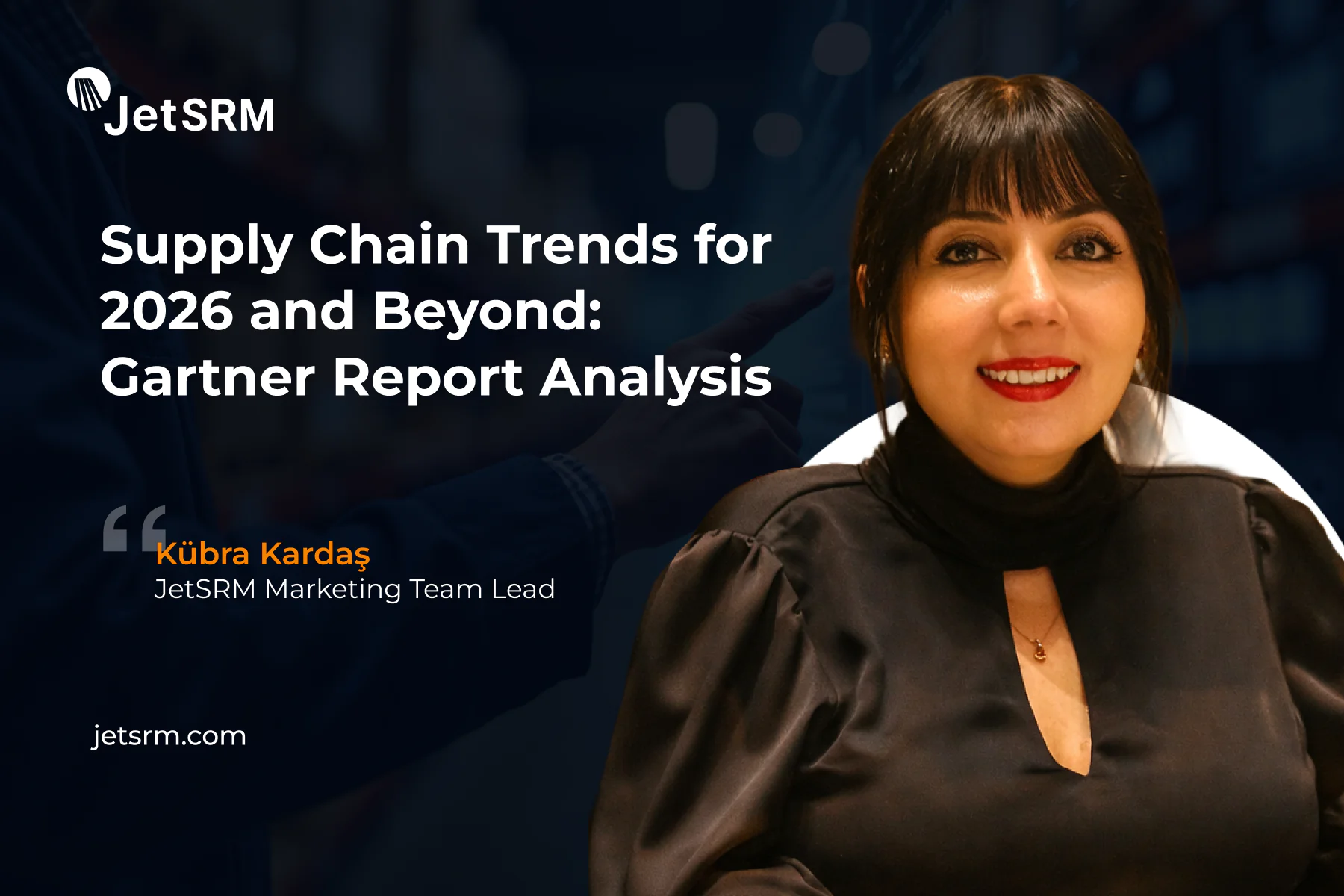
Supply chain trends for 2026, according to Gartner’s research covering 509 global supply chain leaders, are being shaped by three major forces: agentic artificial intelligence, network repositioning, and structural cost optimization. These trends are transforming supply chain management from a back-office function into a strategic growth engine.
Global supply chains have learned hard lessons from recent disruptions and are now building more resilient, data-driven, and intelligent structures. Gartner’s “Future of Supply Chain 2026” research offers a clear picture of this transformation and presents it to professionals in a way they can act on. Below, we take a detailed look at the critical changes awaiting supply chain leaders in 2026 and beyond — and how to prepare for them.
Supply Chain Trends 2026: The Big Picture
Gartner’s research highlights five major drivers. These drivers are not purely technological — they also encompass geopolitical, economic, and people-centered transformations. High-performing organizations respond to these drivers not in isolation, but through an integrated, cohesive strategy.
| Trend | Gartner Data | Business Impact | Priority |
| Agentic AI | 51% of 509 leaders identified it as the most critical driver | Autonomous decision-making, reduced human intervention | Critical |
| Network Repositioning | US is the #1 destination for operational relocation in 2026 | Cost optimization and geopolitical risk reduction | High |
| Structural Cost Reduction | CSCOs targeting dual-focus execution | Cost reduction must run in parallel with growth | High |
| Workforce Transformation | 55% expect entry-level roles to decline | Role redesign and talent development are essential | Medium |
| Digital Ecosystem | 50% of large organizations shifting to ecosystem model | Data sharing and supplier collaboration strengthening | Medium |
1. The Era of Agentic AI in Supply Chain
Agentic AI is emerging as one of the most defining supply chain trends of the 2026–2027 period. This observation is backed by industry events we attended as MDP Group — including the TÜSİAD SD2 event in late 2025 and the Strategic Procurement Association’s Procurement Summit in early 2026. It is plainly visible that artificial intelligence has become the dominant trend not only in business but in everyday life.
According to Gartner’s October 2025 research, 51% of 509 supply chain leaders identified advancements in agentic AI as the most critical performance driver for the next two years.
How Is Agentic AI Transforming Supply Chains?
While traditional AI systems only provide analysis and recommendations, agentic AI can autonomously make and execute decisions. Autonomous processes deliver groundbreaking results in terms of operational speed and consistency.
Gartner analysts highlight three concrete use cases for AI in supply chain processes:
Agentic demand forecasting: The system autonomously manages data collection, pattern recognition, and predictive modeling. It dynamically optimizes inventory levels and places orders without human intervention.
Agentic supplier selection: It continuously evaluates suppliers based on performance metrics, cost analysis, and reliability scores. It monitors geopolitical risk factors and autonomously conducts supplier negotiations. JetSRM also automates processes such as tender management, negotiation, supplier selection, and supplier document management through AI-driven workflows.
Agentic route optimization: It processes real-time traffic, weather, and fuel price data to instantly update optimal routes.
Gartner predicts that by 2031, 60% of supply chain disruptions will be resolved without human intervention. However, technological maturity and data governance remain critical. The healthiest approach is to expand autonomy gradually, starting with low-risk decisions.
2. Network Repositioning and Regionalization
In 2026 — when the “China+1” strategy is no longer sufficient — supply chain leaders are embarking on comprehensive network restructuring. Gartner’s 2026 CSCO research reveals that the US has risen to become the first choice for operational relocation, with Southeast Asia coming in second.
Factors Accelerating Regionalization
Tariffs and cost optimization pressures are making network relocation unstoppable. Geopolitical tensions and increasing regulations are making long supply lines risky. The US becoming the leading destination for new operations is a concrete indicator of the “re-industrialization” wave.
According to Gartner data, geopolitical tensions and deglobalization trends were identified as critical strategy drivers by 38% of supply chain leaders. This figure shows that network decisions are now being made through the lens of geopolitical risk management, not just efficiency.
3. Balancing Growth with Cost Control: Dual-Focus Execution
2026’s most challenging managerial paradox is this: procurement teams must simultaneously accelerate commercial growth and achieve structural cost reduction. Gartner defines this dynamic as “dual-focus execution.”
Supply Chain Capabilities That Drive Commercial Growth
Gartner’s research shows that high-performing organizations invest in four critical, growth-oriented capabilities:
Capability 1: Trust-based, collaborative relationships with key suppliers
This is one of JetSRM’s strongest areas. Collaboration is only possible in an environment where both parties can access the same information at the same time. JetSRM enables this in the following ways:
Through the JetSRM Supplier Portal, suppliers can view order status, invoice and payment information, action tracking, and contract and quality documents — all from a single screen. No need to call or send emails to find out. This transparency is one of the most important building blocks of trust in a relationship.
Survey & feedback mechanism: Surveys can be published for suppliers, transforming the relationship from a one-way supply dynamic into a mutual development partnership.
Capability 2: Strategies and policies for supply chain risk reduction
JetSRM addresses this capability through three distinct layers:
JetVerify – Document Verification: AI-powered automatic verification of supplier documents (bank details, signature circulars, template compliance) eliminates risks from non-compliant or fraudulent documents at the source.
Supplier Evaluation Module: Generates a multi-dimensional performance score by processing SAP data, portal activities, and survey results together. Criteria such as delivery, quality, price stability, and OHS compliance are weighted to create an objective risk profile for each supplier.
Quality & Contract Management: When a document’s validity period expires, the system sends automatic reminders — reducing the risk of operating outside contractual boundaries.
Capability 3: Social learning environments that support knowledge sharing among supply chain staff
This capability directly aligns with JetSRM’s architectural decisions.
Department-based data visibility: Procurement sees certain data, the quality department sees other data — each team focuses on information relevant to their own processes. This design prevents information overload while also structuring cross-team data sharing.
Central platform: Quotes, tenders, orders, quality documents, contracts, supplier evaluations — all integrated with SAP. When different teams can speak a common language without asking “where is this information?”, organizational learning accelerates.
JetAsistan (AI Chatbot): Carries out approval management, reporting, and quote queries via commands — reducing the learning curve for new team members while embedding institutional knowledge into the system.
Capability 4: Dedicated resources for future talent strategies
JetSRM addresses this capability on two axes:
AI layer (JetAsistan, JetVerify, JetNegotiation, JetInsight): By handing off routine and manual workloads to automation, it enables procurement professionals to focus on strategic work. A procurement specialist who spends all day verifying supplier documents can redirect that capacity to higher-value activities.
Measurable KPI reporting: By reporting historical data and performance metrics in real time, it enables decision-making based on data rather than intuition.
| Gartner Capability | JetSRM’s Response |
| Trust-based collaborative relationships | Supplier Portal, transparent data sharing, free supplier access, survey mechanism |
| Risk reduction strategy | JetVerify, Supplier Evaluation, Audit & Action Management, Quality Management |
| Knowledge sharing & learning environment | Department-based visibility, central platform, JetAsistan |
| Resources for talent strategy | AI modules (automation), Agile implementation, KPI reporting |
4. Redefining Value in GenAI Investments
Gartner’s research surfaces a striking reality: 72% of supply chain organizations use generative AI, yet the majority achieve only mid-level results in terms of efficiency and return on investment. Investing more — or less — in AI is not the solution.
Why Are Results Falling Short of Expectations?
The problem is not with the technology itself, but with the implementation model. Gartner defines three pillars of success: operations; analysts and strategically-oriented employees who provide direction; and ecosystems that support production. Organizations that focus only on operations while neglecting the other two dimensions cannot fully benefit from the efficiency potential of digital supply chain tools.
5. Workforce Transformation: How Will Humans and Machines Work Together?
The rise of agentic AI is fundamentally reshaping the supply chain workforce. 55% of leaders who participated in Gartner’s research predict that agentic AI will reduce the need for entry-level positions. 51% believe it will lead to an overall reduction in the workforce.
The Talent Strategy of High-Performing Organizations
However, a critical distinction exists: high-performing organizations use AI not to reduce headcount, but to redesign roles and enable humans and machines to create value together. These organizations are focusing on three priorities over the next two years:
- Upskilling talent for the AI era
- Using AI-powered tools for workforce planning and candidate engagement
- Increasing automation and advanced technologies to reduce dependence on manual work
86% of respondents agree that agentic AI adoption will require new processes for developing future talent pipelines. This represents not just a technological transformation, but a cultural and organizational one.
6. Sustainability and Regulatory Compliance: A Non-Negotiable Agenda
41% of supply chain leaders identified governments’ use of economic policy as a political tool as a critical strategy driver. According to Gartner, supply chain leaders should address regulatory requirements on two dimensions: integrating legal obligations into strategic decision-making, and leveraging these requirements as a catalyst in the sustainability journey.
Gartner highlighted Schneider Electric — ranked first on the 2025 Supply Chain Top 25 list for the third consecutive year — as the best practitioner in integrating sustainability with strategic business objectives. “The supply chain is no longer a back-office function; it is a central business component that creates resilience and value.”
3 Major Challenges Facing Supply Chain Leaders
CEO pressure: When CSCOs focus on cost control, CEOs tend to believe that the supply chain is not adequately supporting growth. This perception makes it harder for CSCOs to position themselves as high-value business partners.
Low efficiency gains from GenAI: Despite 72% of organizations using GenAI, most are achieving average results. Redefining value and adopting an integrated approach are essential.
Economic volatility: Increasing regulations and geopolitical tensions are deepening long-term economic uncertainty. Addressing root causes, conducting scenario analysis, and building ecosystem partnerships are the primary ways to navigate this challenge.
Preparing for 2026 Supply Chain Trends: Actionable Steps
Gartner’s research shows that the most critical factor differentiating high-performing organizations from the rest is speed and integration. Only 7% of supply chains are capable of implementing decisions in real time. This figure clearly demonstrates how critical investment in digital infrastructure is.
- Launch agentic AI pilot projects: Start with low-risk decisions and expand autonomy gradually. Establish data governance first.
- Update your network map: Conduct geopolitical risk mapping and model regional diversification options.
- Redefine the GenAI value framework: Measure not just operational efficiency, but also employee capacity and ecosystem connectivity.
- Redesign your talent strategy: Map skills for the AI era and launch reskilling and upskilling programs.
- Add sustainability regulations to your strategy roadmap: Position legal requirements as a competitive advantage, not a barrier.
Frequently Asked Questions Based on the Gartner Report
According to Gartner’s research covering 509 supply chain leaders, advances in agentic AI stand out as the most defining trend of the 2026–2027 period. 51% of participants identified this trend as the most critical strategy driver. Agentic AI fundamentally changes operational speed by autonomously making and executing supply chain decisions.
Tariffs, geopolitical tensions, and cost optimization pressures are reshaping supply chain networks. According to Gartner data, the US rose to become the top destination for new operations in 2026. The “China+1” strategy is giving way to comprehensive regionalization and multi-hub network structures.
According to Gartner, the issue is not with the level of investment, but with the implementation model. Despite 72% of organizations using GenAI, the majority achieve mid-level results. Success requires simultaneous investment not only in operations, but also in analytically capable employees and a supportive ecosystem.
55% of participants in Gartner’s research predict that agentic AI will reduce the need for entry-level positions. However, high-performing organizations use AI not to reduce headcount, but to redesign roles and enable humans and machines to create value together.
Gartner’s annual “Future of Supply Chain” research is one of the most comprehensive and reliable sources covering global supply chain leaders. Gartner analyses supported by academic research and industry reports provide a solid foundation for strategic decision-making.
Conclusion
Supply chain trends for 2026 and beyond signal a fundamental paradigm shift. Agentic AI, network repositioning, dual-focus execution, workforce transformation, and sustainability form five critical axes that supply chain leaders must manage simultaneously.
Gartner’s research makes one thing clear: high-performing organizations address these trends proactively, not reactively. Digital infrastructure investment, talent strategy renewal, and ecosystem partnerships are the three foundational pillars of this transformation.
As MDP Group, we support our customers in their supply chain digital transformation journey with our JetSRM solution. You can reach our expert team to turn the new trends in supply chain management into operational reality.